
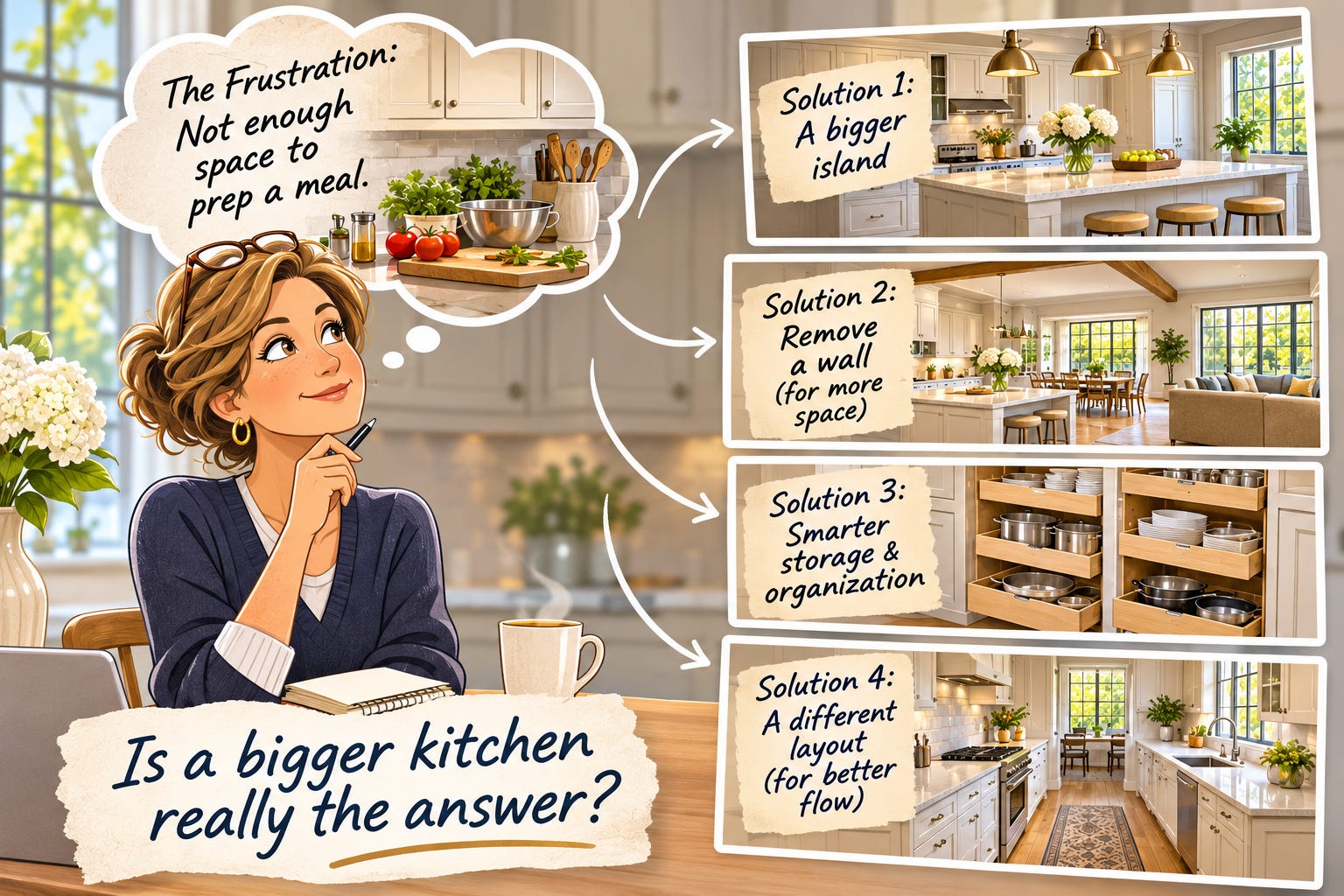
Something about your kitchen isn’t working. Maybe you never have enough counter space. The cabinet storage is like a game of Tetris. Or two people can’t prepare a meal without getting in each other’s way.
Naturally, you start imagining solutions. A bigger island. More cabinets. Removing a wall. Before long, you’re looking at kitchen photographs, layouts, and remodeling ideas.
That’s how most of us approach a problem: we try to fix it. But sometimes we begin choosing solutions before we’ve really understood what’s causing the frustration.
How We Automatically Jump to Solutions
“I don’t have enough counter space” quickly becomes “I need a bigger island.”
“The kitchen feels cramped” becomes “We should remove the wall.”
“Our cabinets are overflowing” becomes “We need more cabinets.”
But what if the real problem is poorly organized storage? Or appliances located where they interrupt the way you work? What if adding an island actually makes it harder to move through the kitchen?
The solution that first comes to mind isn’t necessarily the one that will solve your problem.
Why This Matters to Your Investment
Once you’ve decided what you think the solution is, your research tends to follow that decision. You look for islands, additions, new cabinetry, or larger kitchens—and may overlook other ways to solve the same problem.
It’s a common phenomenon. Beautiful islands, additions, cabinetry and kitchens will appear seemingly out of nowhere; strengthening your desire.
You may think you are making progress with your decisions when you are actually being brainwashed into an emotional response.
Maybe a smaller improvement is enough.
Maybe a different layout is the answer.
Or perhaps a substantial renovation really is the best investment.
The risk isn’t that you haven’t done enough research. It’s that you may be doing extensive research on the wrong solution.
One Question Before You Continue
Before researching your next improvement, ask yourself:
“What specific frustrations am I expecting this to eliminate?”
I suggest the process called “The Seven Why’s”
Take you first frustration and ask yourself why it matters. What you should see is a list of very specific problems that are leading to the initiating frustration.
Now you have real problems that are driving your decision.
Then consider whether there might be more than one way to eliminate them.
You’re not giving up on the solution you want.
You’re making sure it’s the right solution to investigate, you will be immersing yourself in all the potential paths and can compare.
When you see that you have more than one solution, exploring them will strengthen your confidence and understanding. Your focus will shift to what’s important to the life you plan to live inside and outside of those walls before you fall in love with an image.
Next week — 2 of 5: The Most Expensive Remodel Is the Wrong One.
Clarity Before Commitment | Regret-Free Home